
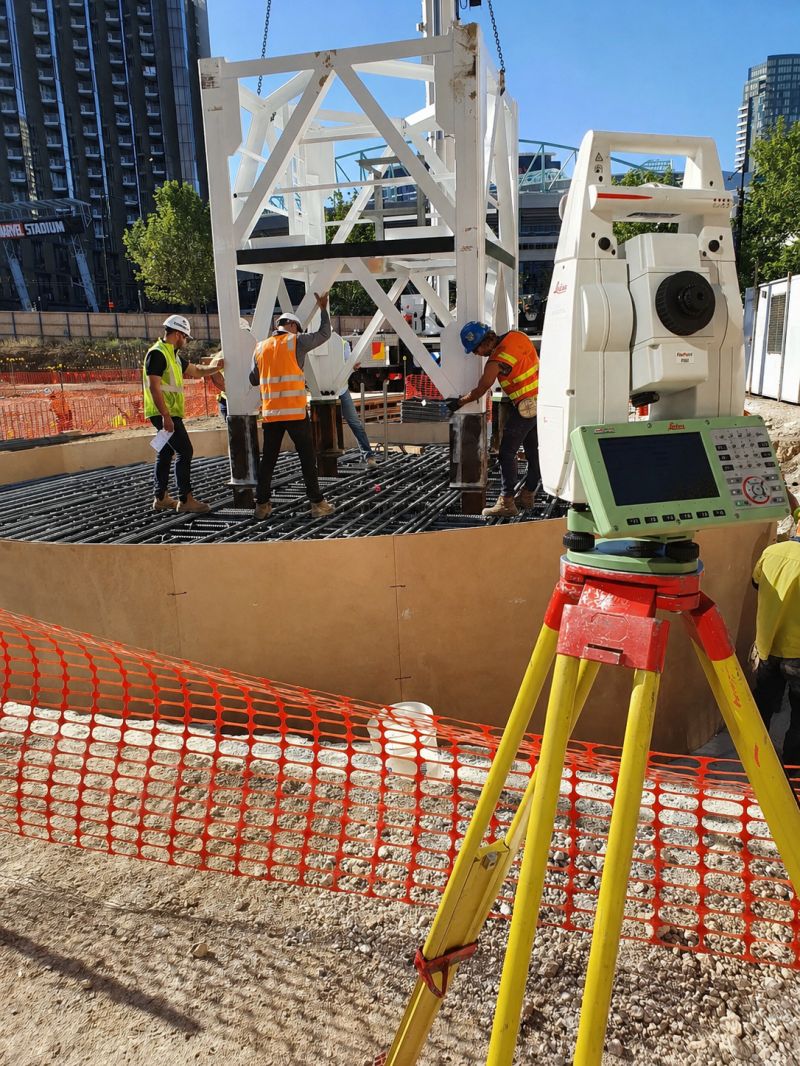
Before a single floor goes up on a high-rise, the crane base has to be right.
It’s one of the earliest and most consequential surveys on any tall building project. The crane base setout involves locking in position, rotation, and level before the crane is installed and before anything above ground level begins. On the surface, it sounds like a relatively contained task. In practice, it’s a reference point that the entire build depends on.
Here’s what makes it more significant than it might appear: the as-built record produced during crane base setout doesn’t just sit in a folder once the crane is up. It becomes the baseline data for the life of that crane on the project. As the building climbs – floor by floor, week by week – that initial survey underpins a series of ongoing checks and measurements that keep the structure accurate and the crane operating safely.
Specifically, the crane base data supports crane verticality checks as the mast climbs, tie-in positioning where the crane is anchored to the building structure at multiple levels, and alignment checks that confirm the crane is tracking correctly as the building rises around it. These aren’t one-off activities. They happen repeatedly throughout the build, and they all trace back to that initial setout.
This is why precision at the crane base stage matters so much. An error introduced at the beginning – even a small one – doesn’t stay small. It becomes the reference for everything that follows, and errors that compound over 30, 40, or 60 floors can have real consequences for the structure and for crane safety. Getting it right the first time isn’t just good practice; it’s what the rest of the project is built on.
The work itself requires a combination of accurate setout, careful level establishment, and a thorough as-built record that captures exactly what was installed and where. The survey team needs to coordinate with the crane contractor and the site superintendent, work around active site conditions, and produce documentation that is clear, precise, and immediately usable for the checks that follow.
It’s also one of those tasks that tends to be invisible when done well. The crane goes up, the verticality checks come back clean, the tie-ins go in at the right positions, and the project moves forward without issue. Nobody stops to think about the survey that made that possible. That’s fine – it’s how it should work.
But for the people responsible for that survey, there’s a clear understanding of what’s at stake. The crane base setout is simple on paper. What it carries through the build is anything but.
Base Surveys provides precise setout and as-built surveys for high-rise and commercial construction across Melbourne. Contact us to discuss your project requirements.