
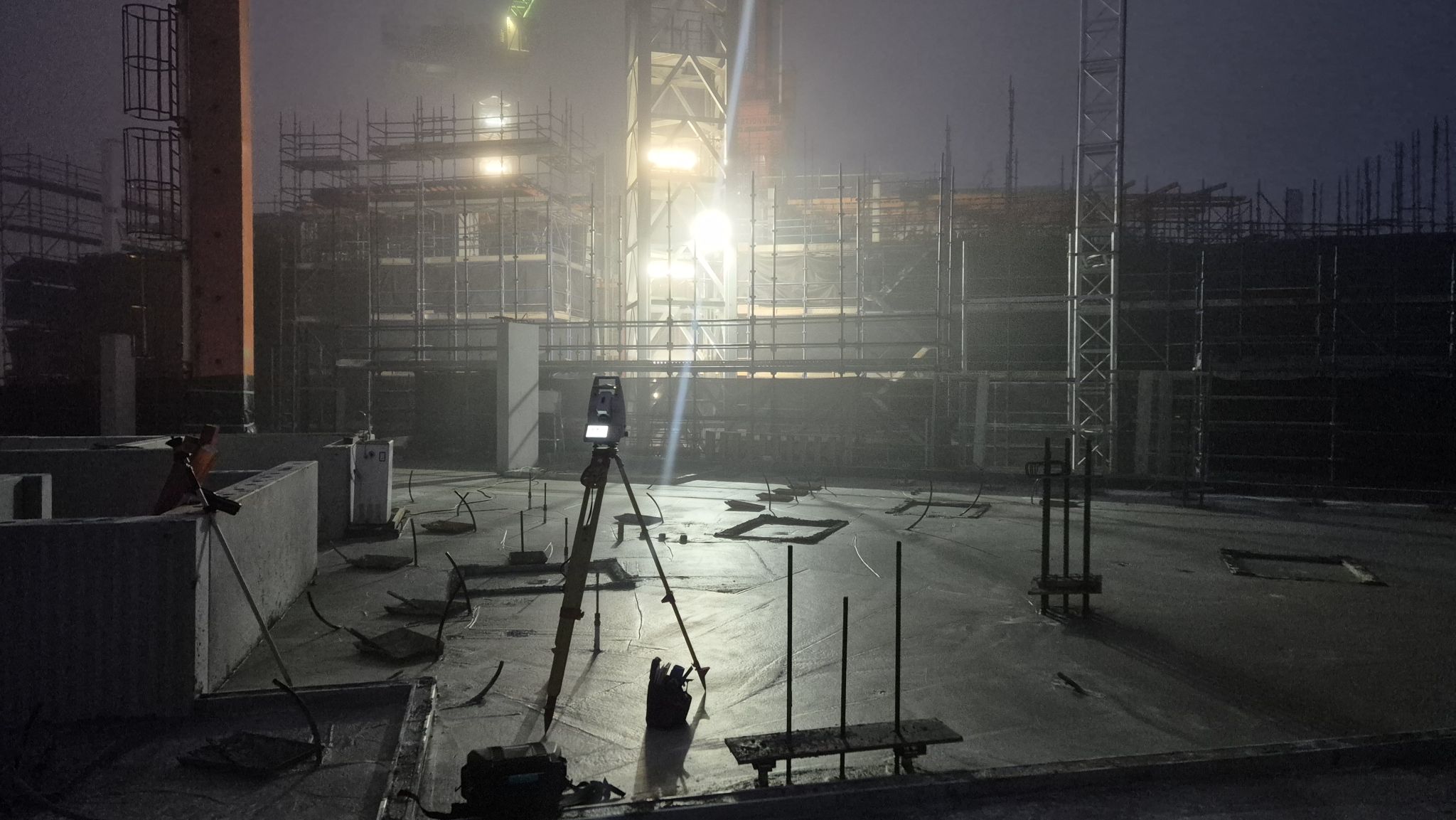
There are mornings on site that don’t go to plan – and this was one of them.
We arrived early, instruments set up and ready to go. The job was straightforward. Then the fog hit. Heavy, low, and total. Visibility dropped to near zero, and with no line of sight available, there was nothing to shoot at. The equipment was ready. The team was ready. The conditions weren’t.
So we waited it out.
It’s a situation most experienced surveyors have been in at some point, and it’s a useful reminder of something that tends to get overlooked when everything is running smoothly: modern construction surveying is heavily dependent on clear sightlines. Total stations, prisms, and control networks all rely on the instrument being able to see its target. When fog, dust, rain, or obstructions get in the way, that chain breaks.
This kind of external control dependency is the norm on most commercial and high-rise construction sites in Melbourne, and for good reason – it’s accurate, efficient, and well-suited to complex setout work. But efficiency only holds up when conditions cooperate. On a morning like this one, the limitation becomes very visible, very quickly.
That’s part of why traditional methods like plumbing up still have a legitimate place in a surveyor’s toolkit. Plumbing up – transferring a point vertically through a structure using an optical or laser plummet – doesn’t require an external sightline. It works floor to floor, inside a core, regardless of what the weather is doing outside. It’s not always the fastest approach, and it’s not the right tool for every situation. But when conditions strip away your other options, having that knowledge and capability matters.
The same logic applies to other field techniques that predate modern total stations. They persist not because the industry is slow to modernise, but because experienced surveyors know that technology and conditions don’t always align. A good surveyor doesn’t just know how to use the best tool available – they know what to do when that tool can’t be used.
Construction timelines rarely have much tolerance for delays. A project running to programme doesn’t want to hear that the survey couldn’t happen because of visibility. Being able to adapt – whether that means switching methods, adjusting the sequence of work, or finding a way to get accurate data under difficult conditions – is a core part of what makes a surveying team genuinely useful on a job site.
The fog cleared eventually that morning, and the work got done. But the reminder was worth having: plan for the conditions you can’t control, and know your options when they work against you.
Need a surveying team that knows how to adapt on site? Get in touch with Base Surveys.