
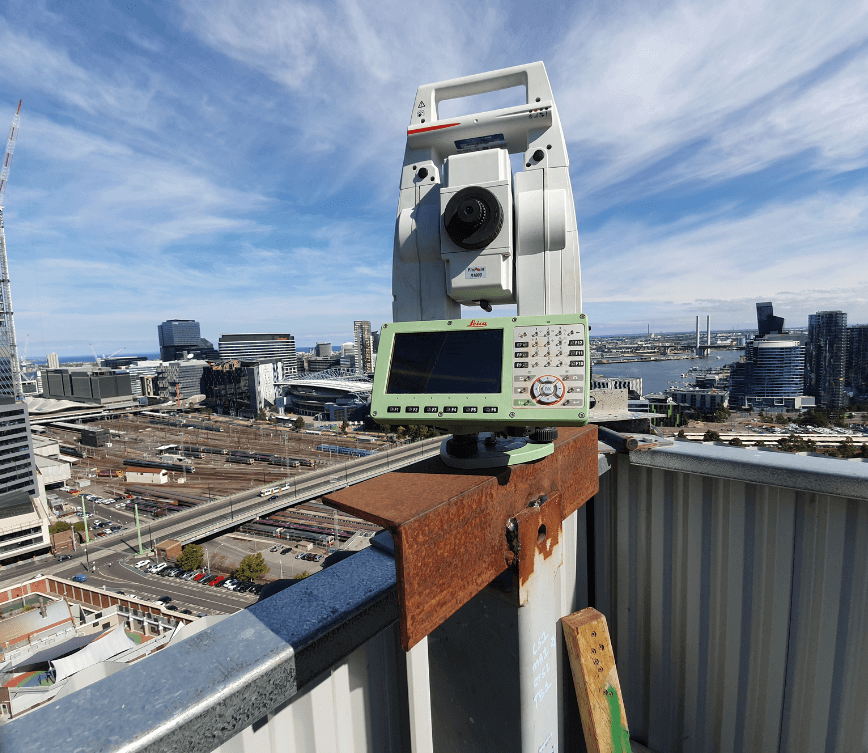
Sometimes the site doesn’t give you what you need. The job of a good surveyor, in part, is to figure out how to get the work done anyway.
On a recent job, a tripod setup simply wasn’t an option. The available position for the instrument didn’t allow for it – the geometry of the space, the surface conditions, or both made a standard tripod setup unworkable. Rather than write off the position and find a workaround that would add time and complexity to the job, the solution was more direct: flatten a piece of PT tube, fix it in place with two concrete nails, and mount the instrument on that instead.
It worked. The instrument was stable, the setup was accurate, and the work proceeded.
This kind of field improvisation doesn’t make it into textbooks, and it’s not the sort of thing that gets discussed in a tender document. But it’s a genuine part of what experienced surveyors do on real construction sites. Buildings are messy, dynamic environments. Conditions change. Spaces that were accessible last week are blocked off this week. Surfaces that should be flat aren’t. Equipment that was planned for one setup position turns out to be unworkable once you’re actually standing there.
The ability to solve those problems quickly – safely, accurately, and without disrupting the broader programme – is something that develops through years of site experience. It’s a different kind of skill to the technical precision of the survey itself, but it’s just as important in practice. A surveyor who can only work under ideal conditions is limited in their usefulness on a real job site.
There are boundaries to this, of course. Improvised solutions still need to meet the accuracy requirements of the work. A creative setup that introduces error or instability into the instrument is worse than no setup at all. The PT tube solution worked because the result was verifiable – the instrument was properly levelled and the data came back correct. Field improvisation is only useful when it produces reliable results.
That judgement – knowing when an improvised solution is good enough, and when it’s not – is exactly the kind of thing that separates experienced surveyors from inexperienced ones. It’s not recklessness. It’s confidence, backed by the technical knowledge to verify that what you’ve done is sound.
Construction doesn’t slow down for equipment challenges. The best surveying teams find a way to keep moving.
Base Surveys brings practical, experienced problem-solving to every site. Talk to us about your next project.