
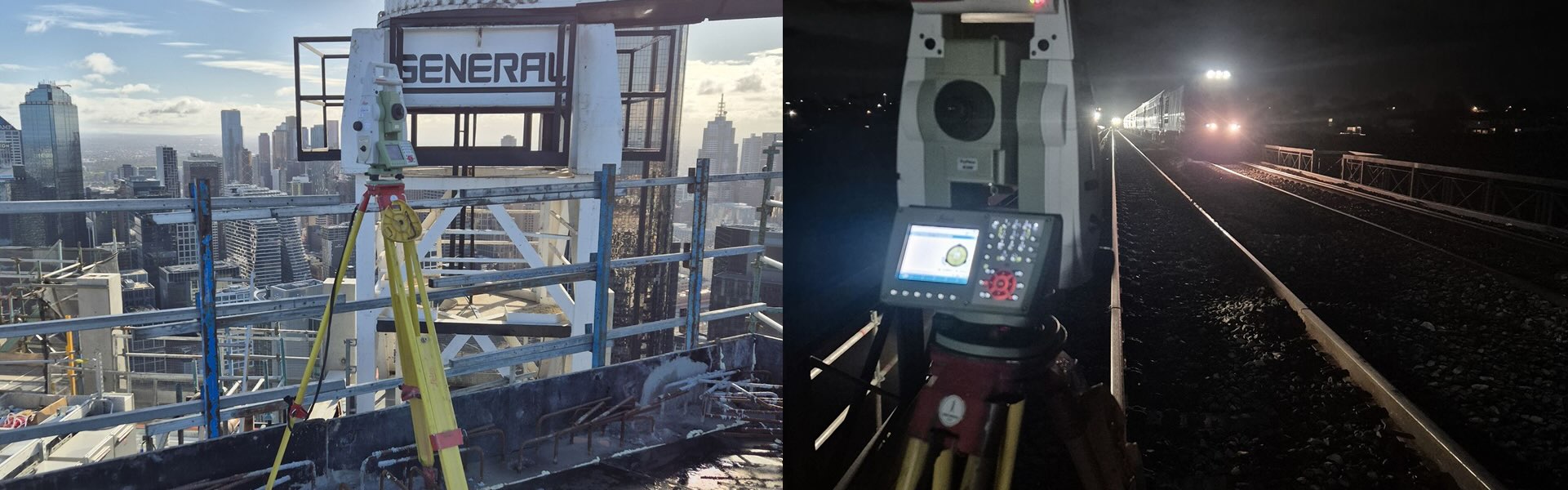
One of the things that makes engineering surveying genuinely interesting – and genuinely demanding – is that no two sites are the same.
One night you’re on a rail corridor in the small hours, total station running, a train in the distance, working in the kind of quiet that only exists when the rest of the city is asleep. The environment is controlled, the access window is tight, and the pressure is on to get accurate data and clear the track before operations resume.
The next morning you’re setting out on the 65th floor of a city tower, with Melbourne laid out below you and the wind doing everything it can to make your job harder. The scale is different, the logistics are different, and the risks are different – but the precision required is exactly the same.
This contrast is something the team at Base Surveys encounters regularly. Melbourne’s construction and infrastructure landscape is diverse: high-rise residential and commercial development in the CBD and inner suburbs, rail and road infrastructure projects across the metro network, civil works in growth corridors to the north and south-east. Each type of project has its own demands, its own access conditions, and its own surveying challenges.
Rail corridor work, for example, typically involves tight possession windows – short periods where the track is taken out of service to allow work to proceed. Everything needs to be planned and executed precisely within that window. There’s no coming back the next day if the setup takes too long. Night work on rail requires a different level of preparation, situational awareness, and field efficiency than a standard daytime setout on a construction site.
High-rise setout brings its own complexity. Transferring control vertically through a building as it climbs, managing the effects of wind movement on tall structures, coordinating with trades and site management on a busy construction floor – these are skills that develop through repetition across many different projects.
What doesn’t change across any of these environments is the fundamental requirement: the data needs to be right. A setout error on a rail line can have serious consequences for track geometry and safety. An error high up on a building structure can compound through every floor above it. The variety of work keeps the team sharp, but the standard of accuracy stays constant regardless of where or when the work is happening.
That adaptability – being equally capable and equally precise whether you’re on a rail line at 2am or a tower at 65 storeys – is something Base Surveys takes seriously. It’s built through experience across a wide range of projects, and it shows in the consistency of the work.
From rail infrastructure to high-rise construction, Base Surveys operates across Melbourne and Victoria. Contact us to discuss your project.